You are just about ready to go fly fishing…
You’ve got your new fly rod, your fly reel, your fly line, your leader and tippet.
Aside from a few practice casts, all you need now is to tie on a fly.
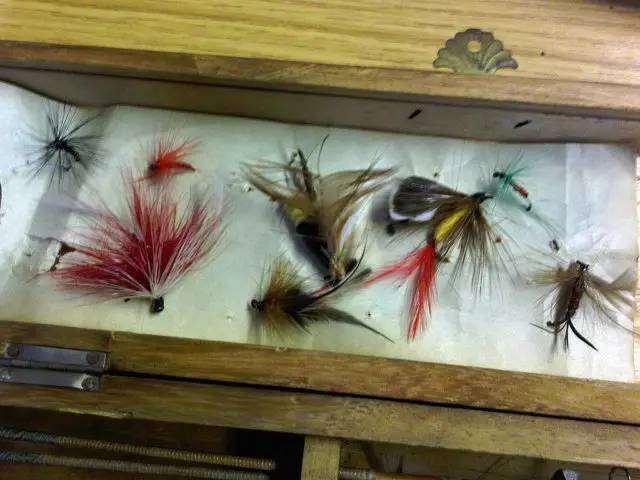
So Many Flies To Choose From
Fly is a pretty broad term for such a small word.
Flies are creations tied — usually with thread, feathers, fur, wire and beads — onto a hook to resemble something that a fish might want to eat.
I remember reading somewhere that the original artificial flies were tied to represent flying insects, hence the name “fly”.
In today’s fly fishing, a fly can mimic almost anything a fish might eat — everything from a tiny flying midge to a mouse, from a waterborn worm to a snake. You name it, and somebody has probably tried to tie up an imitation version of it if they thought a fish might be willing to eat it.
If you want to be overwhelmed with choices, just step up to the fly bin and have a look-see.
A good fly shop will have dozens of different types of flies in stock and in several sizes of each type.
It’s not uncommon for us to have over 10,000 flies in stock at any one time. Yes, I said 10,000 flies! We’re not even a big fly shop.
There are wet flies that sink below the surface and dry flies that ride on top of the water. There are flies so small I need a magnifying glass to even see the eye of the hook. There are flies made so large you can catch fish bigger than a human with them.
Size Matters. It Depends On Your Hook
The size of a fly is determined by the size of the hook it’s tied on.
Hook sizes are a funny point to me. They are bass-ackwards. A size 6 hook is much larger than a size 16 and a size 26 is absolutely tiny. I don’t know why that is, but maybe I need to research that just to put my mind at ease. Hmm, maybe.
Anyway, most of my trout fly fishing is done with flies from size 6 to size 24.
What size is best? The size the fish want. Ahahahaha. OK, not that funny, but very true. You’ll see.
Someone suggested that I write a list of flies that everyone should have in their arsenal. I tried, but I couldn’t figure out how to write a list of flies that would work for everyone. Each angler will most certainly need specific flies for their specific waters.
Your objective now is to find out what type of fish are in the water you want to go fishing in and what kinds of bugs might those fish be eating. Then buy some flies that represent those bugs you are likely to find. I said bugs, but they could be fish imitation flies as well, or worms or leaches or crawdads or even fish eggs.
Here’s the deal: Don’t make it harder than it is. This is supposed to be fun, relaxing even. Don’t let it be overwhelming.
I’ve said it before and I’ll say it again, before you buy any equipment, I would make a couple of visits — or more — to the fly shop in your area. Get to know the man or woman behind the counter. Don’t be shy about telling them you are new to the passion. Get your eyes and hands on some equipment.
I’d even suggest you sign up for fly casting lessons before you buy anything. I’d also suggest you go with a fly fishing friend (or hire a guide) for at least one day and actually try it before you buy any gear. They will provide everything you need — including some first timer instruction. You just go along and get acquainted with the process, the gear, and maybe even catch a fish or two.
Sharp hooks and tight lines,
Ron