Fly fishing hatch charts can be a great tool for helping you plan a fly fishing trip.
Using a hatch chart can help you determine what kind of bugs are hatching, in what part of the country, during what time of the year.
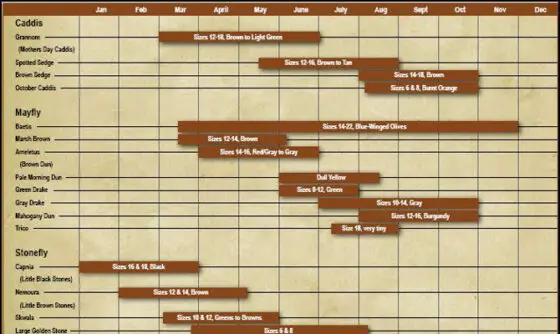
Basically, a hatch chart is a graph or calendar, marked with that information, based on bug activity from previous years.
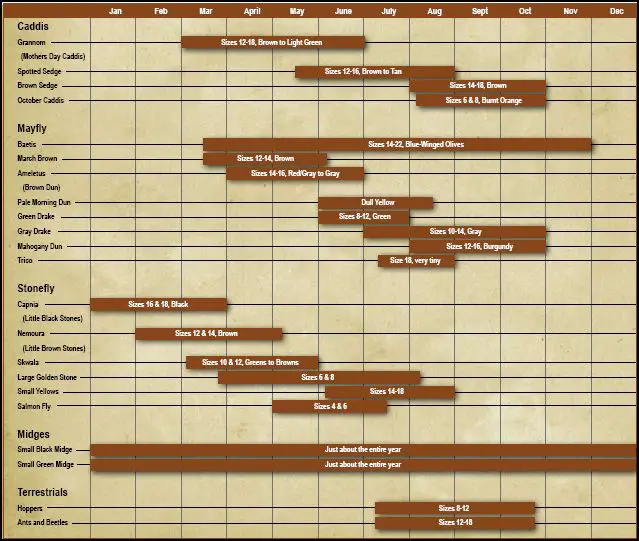
Look at this one and you’ll see what I mean. I helped put this one together for the area of Montana I guide in the most:
Hatch Charts = Emergence Charts
In nearly every how-to book of fly fishing you can buy today, they tell you about hatch charts.
I feel compelled to tell you, the phrase hatch chart kinda sticks in my craw.
In my humble opinion, that phrase is not entirely correct.
Here’s my way of thinking…
I grew up a farm boy. We had chickens and cows and horses. I had to gather eggs every morning. If I had an egg in my hand to take to the skillet for breakfast, it wasn’t hatched. If I went out and found some chicks clustered around a mother hen, they’d done hatched. Are you gettin’ my drift?
In my little mind, when a living organism breaks out of the egg and enters the environment, what we know as this world, that event marks a hatch.
When a bug, that came out of the egg a long time ago and has been living on the bottom of the river in the mud or under a rock and then makes the swim up through the water column and emerges from the water into the air, emerging from its watery, juvenile home into that of an airborne adult, that’s an emergence.
Of course, some bugs you find on the hatch charts and on the river don’t fit into the emerger category. They are blown onto, crawl up into, or drop onto the surface of the water. Those are called terrestrials.
Like a grasshopper that takes a big leap and is caught by the wind and finds itself on the water’s surface. An earthworm with a messed up GPS system that crawls out of the mud into the water. Another example is an ant or a beetle that falls off of an overhanging tree limb or rolls down the bank and into the water.
Those land-based (or terrestrial insects) in their normal day to day life, have no business being on the water. Very often though, a terrestrial insect, through some act of mother nature or other circumstances beyond their control, find themselves floating on, drifting through or sinking in a river or lake.

I can’t help but believe that said terrestrial insect, when it finds itself trapped in water, is thinking, "Ah dang, something ain’t right here. This ain’t good."
It would be like you, falling out of an ocean liner during a love boat cruise, into shark-infested waters. Might as well ring the dinner bell for the finned predators, and it would suck to be you. Or the grasshopper. Or the earthworm. Or the ant. Or the beetle. Ad nauseam.
I think they should call those charts emergence charts.
Wait. Hold on a minute. This just hit me. Maybe even better. They should call those charts the what bugs you should be able to find on the water that the fish should be eating during a certain time of year in a certain part of the world charts. Doesn’t exactly roll off of the tongue, but I like it.
Turns out, nobody ever asked me how I felt about the subject before they wrote all of those hifalutin fly fishing books. Go figure.
Anyway, if you look at the hatch chart I posted above, you can see what fish dinners you should be able to find in my general area during what time of the year. A chart like that can help you determine what kind of flies you should probably take to the river or lake during your fishing trip. It can also help you determine during what time of the year you want to plan your trip.
Using A Hatch Chart To Plan Your Trip
Here’s how a hatch chart may be useful in helping you plan a fishing trip.
Let’s say you love to watch a trout take a dry fly on the surface but aren’t that thrilled about drifting a midge below a strike indicator. Looking at the hatch chart will show you that you probably aren’t going to be doing your kind of fishing if you go during the December midge season. Make sense?
Instead, you’d probably want to plan your trip during the expected apex of the hopper season. By the way, that’s my favorite. Huge dry flies. Explosive takes. Makes my knees weak. Makes my pulse quicken. Makes my day.
Where To Find Hatch Charts
There are a bazillion hatch charts out there.
Orvis has a hatch chart for the Eastern and Midwestern US. They also have a hatch chart for the Western US. Keep in mind, those are fairly generalized by a huge region.
If you are trying to plan a fishing vacation to some cross country, or across the world destination for that matter, it would be best for you to contact a good fly shop in the area you are planning on visiting and ask them to direct you to a good hatch chart for that area. A good fly shop will be happy to help you.
Sharp Hooks and Tight Lines,
Ron

I'm a fly fishing guide in Montana. One of my greatest pleasures in life is introducing people to fly fishing — watching them catch their first fish on a fly, and watching them 'get it' when it all comes together. I love sharing what I've learned in an easy-to-understand manner.